
Understanding Fick’s Law: Legal Insights
Fick’s Law of Diffusion represents one of the most fundamental principles in chemistry and physics, yet its applications extend far beyond laboratory settings into the realm of legal practice, particularly in cases involving environmental contamination, product liability, and expert testimony. Named after Adolf Fick, who formulated this law in 1855, it describes how particles move from areas of high concentration to areas of low concentration. In legal contexts, understanding Fick’s Law becomes crucial when addressing cases involving toxic exposure, chemical migration through soil and groundwater, pharmaceutical distribution, and workplace safety standards.
The intersection of scientific principles and legal frameworks creates unique challenges for attorneys, expert witnesses, and judges who must comprehend complex diffusion processes to evaluate evidence, assess liability, and determine appropriate remedies. Whether dealing with environmental litigation, personal injury claims, or regulatory compliance matters, legal professionals increasingly encounter Fick’s Law as a foundational concept that underpins expert testimony and scientific evidence presentation.
Fick’s Law Fundamentals and Scientific Basis
Fick’s Law of Diffusion provides a mathematical framework for understanding how substances move through various media. The first law, expressed as J = -D(dC/dx), describes the flux of particles moving through space, where J represents the diffusion flux, D is the diffusion coefficient, and dC/dx represents the concentration gradient. For legal professionals, grasping these fundamentals proves essential when evaluating expert reports, cross-examining witnesses, and understanding the limitations of scientific evidence.
The second law of diffusion, which incorporates time as a variable, becomes particularly relevant in litigation contexts where establishing timelines of contamination or exposure proves critical. This temporal dimension allows experts to calculate how long a substance would have taken to migrate from its source to a point of exposure, directly impacting liability determinations and damages calculations. Understanding whether a defendant had sufficient time to discover and remediate a problem often hinges on applying Fick’s Law calculations to specific factual scenarios.
Legal teams must recognize that diffusion rates vary significantly depending on multiple factors including temperature, pressure, the nature of the medium through which diffusion occurs, and the properties of the diffusing substance itself. These variables create opportunities for legitimate scientific debate during litigation, where competing experts may present different interpretations of how quickly a contaminant would have spread under specific environmental conditions. The admissibility of such evidence depends on meeting standards established by U.S. courts, including the Daubert standard, which evaluates the reliability and relevance of expert scientific testimony.

Application in Environmental Law
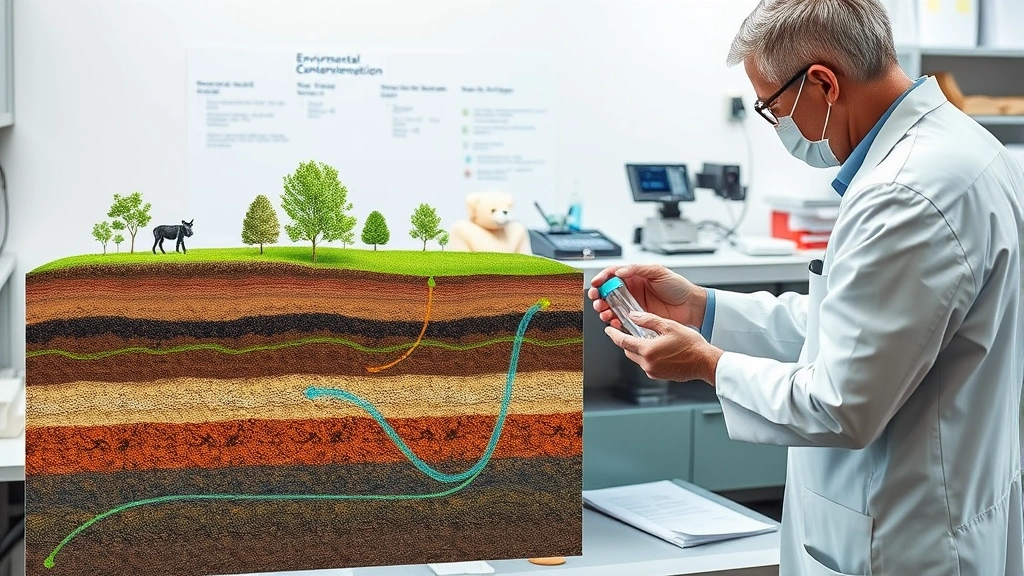
Environmental litigation frequently involves disputes over soil and groundwater contamination, where Fick’s Law provides the scientific foundation for understanding contaminant migration. Property owners, regulatory agencies, and potentially responsible parties must comprehend how pollutants spread through subsurface environments, as this directly affects liability allocation, remediation costs, and the scope of required cleanup efforts.
In cases involving industrial facilities, manufacturing plants, or hazardous waste sites, Fick’s Law helps establish whether contamination discovered at a particular location could have originated from a specific source. Expert witnesses calculate diffusion rates to demonstrate the timeline and pathway of contamination, which may exonerate some defendants or strengthen claims against others. This scientific analysis becomes the cornerstone of environmental damage assessment and can influence settlement negotiations significantly.
The Environmental Protection Agency (EPA) and state environmental agencies rely on diffusion principles when establishing remediation standards and determining safe exposure levels. Legal practitioners working on environmental matters must understand how regulatory agencies apply these scientific principles to their enforcement actions, as this knowledge informs defense strategies and compliance planning. When filing complaints with environmental agencies, understanding the scientific basis of diffusion strengthens your position.
Groundwater contamination cases present particularly complex applications of Fick’s Law, as the aquifer environment involves multiple variables affecting diffusion rates. The permeability of soil, groundwater flow rates, temperature fluctuations, and the chemical properties of contaminants all influence how quickly and extensively pollution spreads. Expert testimony explaining these factors helps judges and juries understand why contamination may have traveled unexpected distances or why certain cleanup approaches prove necessary.
Product Liability and Chemical Exposure Cases
Fick’s Law plays a crucial role in product liability litigation involving chemical exposure, particularly in cases where plaintiffs claim that hazardous substances penetrated protective barriers or migrated through packaging materials. Manufacturers must understand how their products’ chemical components might diffuse through various materials to design adequate warnings and protective measures. When these safeguards prove inadequate, Fick’s Law provides the scientific explanation for how exposure occurred.
In cases involving pesticides, cleaning products, or industrial chemicals, expert witnesses apply diffusion principles to demonstrate whether a manufacturer should have reasonably anticipated that their product could migrate through gloves, skin, or other barriers. This foreseeability analysis directly impacts negligence determinations and punitive damages considerations. The diffusion rate of a chemical through latex or nitrile gloves, for example, can establish whether a manufacturer’s failure to warn about glove permeability constitutes a design defect.
Cosmetic and personal care product litigation increasingly involves diffusion science, particularly regarding claims that harmful substances penetrate skin barriers. Understanding the rate at which chemicals diffuse through skin layers helps establish causation in toxic tort cases and informs regulatory compliance strategies. Manufacturers must conduct diffusion studies during product development to ensure compliance with safety standards and to provide adequate warning labels.
Expert Testimony and Evidence Standards
When Fick’s Law appears in litigation, its presentation as expert testimony must satisfy stringent admissibility standards. Under the Daubert framework, courts evaluate whether the scientific methodology employed by experts represents generally accepted scientific principles and whether the expert’s application of these principles to the specific case is reliable and relevant. Expert witnesses must demonstrate that their diffusion calculations are based on accepted scientific literature and that they have applied appropriate assumptions to the facts at hand.
The reliability of diffusion modeling depends heavily on the quality of input data and the reasonableness of assumptions made by the expert. Courts scrutinize whether experts have accounted for all relevant variables and whether they have used appropriate diffusion coefficients for the specific substances and media involved. Cross-examination often focuses on alternative assumptions that might lead to different conclusions, highlighting the importance of transparent methodology in expert reports.
Legal teams should understand that peer-reviewed scientific literature on diffusion provides crucial support for expert testimony. References to established scientific journals, textbooks, and academic research databases strengthen an expert’s credibility and help establish that their methodology reflects accepted scientific practice. When challenging opposing experts, attorneys should be prepared to identify methodological flaws, unsupported assumptions, or contradictions with established diffusion science.
Workplace Safety and Regulatory Compliance
OSHA and other workplace safety regulators apply diffusion principles when establishing exposure limits and safety standards for chemical handling. Legal compliance requires understanding how toxic substances might diffuse through air, protective equipment, or workplace environments. Employers must implement controls based on realistic diffusion scenarios to protect workers from harmful exposure.
When reporting workplace safety concerns, employees and their representatives should understand how diffusion rates affect exposure levels and health risks. Expert testimony regarding diffusion can establish whether an employer’s safety measures adequately controlled exposure to hazardous substances. This becomes particularly important in cases involving chemical spills, inadequate ventilation systems, or protective equipment failures.
Occupational health litigation frequently involves disputes over whether workers received adequate protection from chemical exposure. Fick’s Law calculations can demonstrate how quickly toxic fumes would have diffused through a workplace environment or how thoroughly a chemical might have penetrated protective clothing. These scientific determinations directly impact workers’ compensation claims and personal injury lawsuits against employers or equipment manufacturers.
Regulatory agencies like OSHA publish exposure limits based partly on diffusion science, establishing maximum allowable concentrations that account for how quickly workers might absorb hazardous substances. Understanding these regulatory standards and their scientific foundation helps employers implement compliant safety programs and helps employees recognize when their workplaces fail to meet required protections.
Pharmaceutical and Medical Device Litigation
The pharmaceutical industry relies extensively on diffusion science to develop effective drug delivery systems. When medications fail to deliver therapeutic doses or when unexpected absorption patterns cause adverse effects, Fick’s Law becomes central to product liability litigation. Expert witnesses calculate diffusion rates through skin, mucous membranes, and other biological barriers to establish whether manufacturers should have anticipated particular exposure patterns.
Transdermal patch litigation frequently involves diffusion analysis, as these delivery systems depend entirely on controlled diffusion of active ingredients through skin. When patches fail to deliver consistent doses or when overdose occurs due to unexpected diffusion rates, Fick’s Law provides the scientific framework for establishing manufacturer liability. Similarly, oral medication absorption involves diffusion processes that must be understood to evaluate whether formulation changes caused adverse effects.
Medical device cases involving implants or internal exposure to chemical leachates often require diffusion analysis to establish causation. Materials used in joint replacements, dental implants, and cardiovascular devices may release chemical components that diffuse through surrounding tissues. Understanding these diffusion processes helps establish whether device manufacturers should have anticipated particular health risks and whether adequate warnings were provided.
Presenting Fick’s Law in Court
Successfully presenting Fick’s Law and its applications to judges and juries requires translating complex mathematics into understandable concepts. Expert witnesses should use visual aids, animations, and simplified explanations that convey the fundamental principle without overwhelming the fact-finder with unnecessary mathematical complexity. The goal is to help the court understand not just the conclusion, but the scientific reasoning that supports it.
Effective expert testimony explains the meaning of key variables in Fick’s equation and why certain assumptions were necessary. Experts should describe how they obtained diffusion coefficients, what environmental or biological conditions they assumed, and how sensitive their conclusions are to variations in these assumptions. This transparency allows opposing counsel to identify potential weaknesses while helping the court understand the reliability of the analysis.
When considering mediation versus arbitration for cases involving complex scientific evidence, understanding Fick’s Law helps parties evaluate settlement proposals and assess litigation risk. Neutral evaluators and arbitrators with scientific backgrounds may appreciate detailed diffusion analysis, while mediation might benefit from simplified explanations that help parties understand their relative positions.
Demonstrative exhibits should show how concentration gradients change over time, illustrating the diffusion process in ways that make the science accessible. Graphs, charts, and animations can help explain why a substance might have reached a particular location at a particular time, or conversely, why contamination could not have come from a suspected source given the timeline involved. These visual presentations often prove more persuasive than mathematical equations alone.
FAQ
What is Fick’s Law of Diffusion?
Fick’s Law describes how particles move from areas of high concentration to areas of low concentration. The first law relates diffusion flux to the concentration gradient, while the second law incorporates time to show how concentration changes at a given location over time. Both forms have important applications in legal cases involving contamination, exposure, and product liability.
How does Fick’s Law apply to environmental contamination cases?
In environmental litigation, Fick’s Law helps experts calculate how quickly contaminants would migrate through soil and groundwater. These calculations establish timelines for contamination spread, identify potential sources, and determine the extent of required remediation. The diffusion rate analysis directly impacts liability determinations and damages assessments.
Can Fick’s Law be used to determine if a chemical exposure occurred?
Yes, diffusion analysis can establish whether a chemical would have been present at a particular location at a particular time. By calculating diffusion rates under specific environmental or biological conditions, experts can demonstrate whether exposure through a particular pathway was possible, supporting or undermining causation arguments in toxic tort litigation.
What standards apply to expert testimony involving Fick’s Law?
Expert testimony about diffusion must satisfy the Daubert standard, demonstrating that the methodology is scientifically reliable, based on accepted scientific principles, and appropriately applied to the facts of the case. The expert must explain their assumptions, identify their data sources, and acknowledge limitations of their analysis.
How does diffusion affect workplace safety regulations?
OSHA and other workplace safety agencies base exposure limits partly on diffusion science, accounting for how quickly workers absorb hazardous substances. Employers must implement controls based on realistic diffusion scenarios, and health agencies use diffusion principles to establish safe exposure levels for various chemicals.
What role does Fick’s Law play in pharmaceutical litigation?
Pharmaceutical cases frequently involve disputes over drug delivery rates and unexpected absorption patterns. Fick’s Law helps establish whether manufacturers should have anticipated particular diffusion rates through skin or biological membranes, supporting product liability claims when delivery systems fail or cause unexpected adverse effects.


