
Hubble’s Law stands as one of the most significant discoveries in modern cosmology, fundamentally reshaping our understanding of the universe’s nature and origin. Named after astronomer Edwin Hubble, who made the groundbreaking observations in the 1920s, this law reveals that galaxies are moving away from us at velocities proportional to their distances. This discovery transformed astronomy from a static worldview to a dynamic, expanding universe model that forms the foundation of modern cosmological theory.
The implications of Hubble’s Law extend far beyond theoretical physics. Understanding this principle has revolutionized how scientists approach fundamental questions about existence, time, and the cosmos itself. Much like how legal frameworks establish foundational principles for society—similar to how we examine the difference between felony and misdemeanor in criminal law—Hubble’s Law provides the cornerstone for contemporary cosmological understanding.
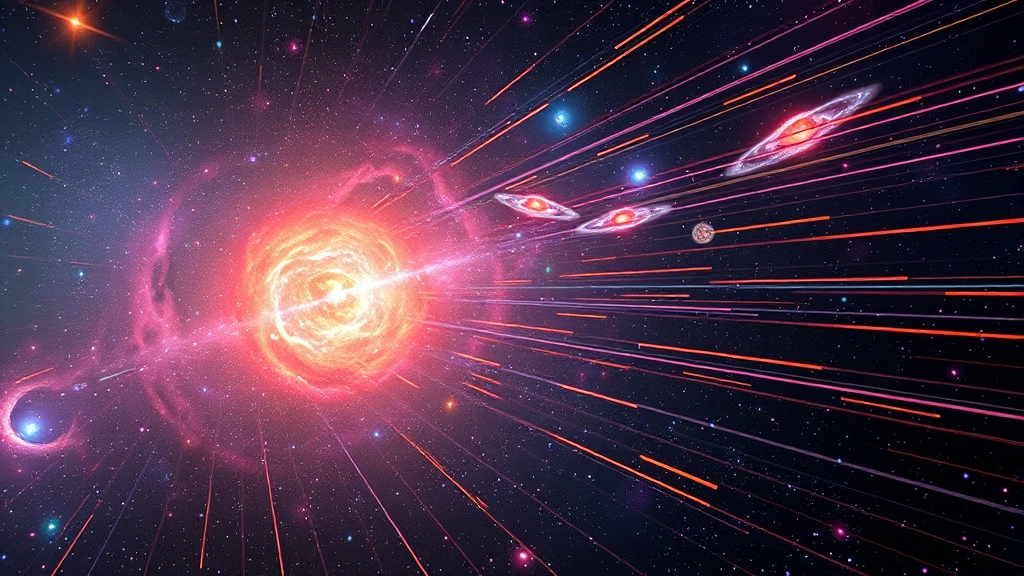
Historical Background and Discovery
Edwin Hubble’s observations in the 1920s revolutionized astronomy by providing concrete evidence that the universe extended far beyond the Milky Way. Working at the Mount Wilson Observatory in California, Hubble utilized advanced telescopic technology to observe distant galaxies and measure their light spectra. His meticulous work demonstrated that spiral nebulae were actually separate galaxies lying outside our own galactic system—a discovery that fundamentally altered our cosmic perspective.
Prior to Hubble’s work, astronomers engaged in the “Great Debate” regarding whether the universe consisted solely of the Milky Way or contained multiple galaxies. Hubble’s observations resolved this question definitively, establishing that the universe was vastly larger than previously conceived. This breakthrough required both technical innovation and theoretical insight, much like how legal professionals must combine procedural knowledge with substantive understanding—as explored in discussions about what is legal malpractice in professional practice.
The collaboration between Hubble and physicist Milton Humason proved essential to these discoveries. Humason’s spectroscopic measurements of galaxy light shifts provided the empirical data necessary to establish the velocity-distance relationship. Together, they gathered observations that would support the revolutionary conclusion that the universe itself was expanding, not static as Einstein and other contemporary scientists had believed.

The Mathematics Behind Hubble’s Law
Hubble’s Law can be expressed through a deceptively simple mathematical relationship: v = H₀d, where v represents the recession velocity of a galaxy, d represents its distance from Earth, and H₀ (the Hubble constant) represents the proportionality factor. This elegant equation encapsulates one of cosmology’s most profound insights—that the farther away a galaxy lies, the faster it moves away from us.
The mathematical foundation rests on the Doppler effect, the same principle that explains why an ambulance siren’s pitch changes as the vehicle passes. When galaxies move away from us, the light they emit experiences a redshift—the wavelengths stretch to longer, redder portions of the electromagnetic spectrum. By measuring this redshift and comparing it to known spectral lines, astronomers can calculate recession velocities with remarkable precision. The relationship between redshift (z) and velocity follows: v = cz for small velocities, where c represents the speed of light.
Determining accurate distances to galaxies presented—and continues to present—significant challenges. Astronomers employ the cosmic distance ladder, a series of measurement techniques that build upon each other. Parallax measurements from nearby stars provide the foundation, followed by standard candle measurements using Cepheid variables, supernovae, and other distance indicators. Each rung of this ladder requires careful calibration, much like how legal systems build precedent upon precedent to establish binding law of tort and law of torts principles.
Observational Evidence and Methodology
Modern observations confirming and refining Hubble’s Law employ increasingly sophisticated instruments and techniques. The Hubble Space Telescope, ironically named after the law’s discoverer, has provided unprecedented precision in measuring cosmic distances. Ground-based observatories equipped with adaptive optics technology further enhance our ability to observe distant galaxies and measure their properties accurately.
Spectroscopy remains the fundamental observational technique for determining galaxy recession velocities. Astronomers analyze the light spectrum emitted by distant galaxies, identifying characteristic spectral lines and measuring their shift toward the red end of the spectrum. This redshift directly correlates with recession velocity, allowing researchers to map the expanding universe with increasing accuracy. The technique proved so robust that it has been applied to billions of galaxies, providing overwhelming confirmation of Hubble’s original discovery.
Large-scale surveys have mapped millions of galaxies, revealing the universe’s large-scale structure. The Sloan Digital Sky Survey, the 2dF Galaxy Redshift Survey, and more recent surveys like the Dark Energy Survey have generated massive datasets confirming the fundamental validity of Hubble’s Law across cosmic distances. These comprehensive observations demonstrate that the expansion is isotropic—the same in all directions—and homogeneous—consistent throughout space.
The Expanding Universe Model
Hubble’s Law provides observational support for the expanding universe model, which emerged from Einstein’s general relativity equations. The Friedmann equations, derived from general relativity, predict that a universe containing matter cannot remain static—it must either expand or contract. Hubble’s observations confirmed the expansion prediction, validating this theoretical framework.
Understanding the expanding universe requires careful conceptual clarity. The expansion does not mean galaxies move through space away from a central point. Rather, space itself expands, carrying galaxies along with it. This crucial distinction prevents confusion about what lies beyond the universe or why Earth doesn’t occupy a special central position. The expansion is democratic—all galaxies recede from all others in a way consistent with the universe’s homogeneity and isotropy.
The implications prove profound. If we reverse the expansion backward in time, we arrive at a state of extreme density and temperature—the Big Bang. Hubble’s Law thus provides crucial evidence supporting Big Bang cosmology and the universe’s finite age. This realization transformed cosmology from a descriptive discipline to a predictive science capable of addressing fundamental questions about cosmic origins and evolution.
Hubble Constant and Cosmic Distance Measurements
The Hubble constant, H₀, represents one of cosmology’s most important parameters. Its value determines the universe’s expansion rate and, consequently, its age. Current measurements place H₀ at approximately 67-74 kilometers per second per megaparsec, depending on measurement methodology. This seemingly technical detail carries profound implications—different values produce different estimates of the universe’s age, ranging from 13.6 to 13.9 billion years.
The tension between different H₀ measurements represents one of contemporary cosmology’s most intriguing puzzles. Local measurements using nearby supernovae and Cepheid variables yield values around 73 km/s/Mpc, while measurements from the cosmic microwave background radiation suggest approximately 67 km/s/Mpc. This discrepancy, though small in percentage terms, is statistically significant and suggests either systematic errors in measurement or new physics not yet incorporated into standard cosmological models.
Accurate H₀ determination requires precise distance measurements to calibration sources. Astronomers employ several techniques, including parallax measurements of nearby Cepheid variables, observations of Type Ia supernovae, and gravitational lensing measurements. Each method carries different systematic uncertainties, and resolving the tension requires advances in observational precision. The importance of establishing accurate baseline measurements parallels how corporate law requires precise documentation and measurement of contractual obligations.
Implications for Cosmology and Big Bang Theory
Hubble’s Law provides the observational foundation for Big Bang cosmology, the leading scientific model of cosmic origin and evolution. By extrapolating the expansion backward, cosmologists infer that the universe began in an extremely hot, dense state approximately 13.8 billion years ago. The consistency between predictions from Big Bang theory and observations across multiple independent measurement techniques provides compelling evidence for this model.
The law also informs our understanding of cosmic evolution. As the universe expanded and cooled, matter underwent phase transitions—from a quark-gluon plasma to nuclear matter, from ionized plasma to neutral atoms. These transitions left imprints in the cosmic microwave background radiation, which we can observe today. Hubble’s Law thus connects the universe’s present expansion to its past history, enabling us to reconstruct cosmic evolution with remarkable detail.
Dark energy represents perhaps the most profound implication emerging from Hubble’s Law observations. In the late 1990s, astronomers discovered that the universe’s expansion is accelerating, not slowing as expected if gravity alone governed cosmic dynamics. This acceleration suggests that dark energy—a mysterious form of energy permeating all space—comprises approximately 68% of the universe’s total energy content. Understanding dark energy remains one of physics’ greatest challenges, much like how legal professionals must grapple with emerging issues in understanding the legal rights of consumers in the digital age.
Modern Applications and Future Research
Contemporary cosmology builds upon Hubble’s Law while addressing its limitations and extending its applications. Modern redshift surveys map billions of galaxies, revealing large-scale structure including galaxy clusters, superclusters, and cosmic voids. These observations test cosmological models and constrain parameters describing dark matter and dark energy.
The Next Generation of Space Telescopes, including the James Webb Space Telescope, promises even more precise measurements of distant galaxies and their properties. These instruments will enable observations of the universe’s earliest galaxies, potentially testing the limits of our current cosmological understanding. Advanced ground-based observatories will simultaneously map millions of galaxies with unprecedented spectroscopic precision.
Gravitational wave astronomy opens new avenues for testing Hubble’s Law and measuring cosmic expansion. When gravitational waves from merging neutron stars or black holes reach Earth, they carry information about their source’s distance. By combining gravitational wave observations with electromagnetic observations of the same events, astronomers can independently determine the Hubble constant, providing a crucial test of consistency between different measurement techniques.
The pursuit of understanding cosmic expansion raises questions about the universe’s ultimate fate. Will expansion continue forever, with galaxies eventually becoming isolated in an ever-cooling cosmos? Or might unknown physics alter this trajectory? These questions drive contemporary research and represent the frontiers of cosmological science. The importance of establishing accurate how to file a complaint against a lawyer mechanisms in professional fields parallels how scientists must rigorously verify observations and challenge theoretical assumptions.
FAQ
What exactly is Hubble’s Law?
Hubble’s Law states that the recession velocity of galaxies is proportional to their distance from Earth. Expressed mathematically as v = H₀d, it demonstrates that the universe is expanding uniformly in all directions.
How did Edwin Hubble discover this law?
Hubble observed spectral redshifts in distant galaxies and measured their distances using Cepheid variable stars. He noticed that galaxies with greater distances exhibited larger redshifts, indicating faster recession velocities, leading to the formulation of his law.
What is the Hubble constant?
The Hubble constant (H₀) is the proportionality factor in Hubble’s Law, currently measured at approximately 67-74 kilometers per second per megaparsec. It determines the universe’s expansion rate and age.
How does Hubble’s Law support Big Bang theory?
By reversing the expansion backward in time, Hubble’s Law suggests the universe originated from an extremely hot, dense state. This provides observational support for Big Bang cosmology and allows cosmologists to estimate the universe’s age.
What is dark energy’s relationship to Hubble’s Law?
Observations of distant supernovae revealed that the universe’s expansion is accelerating, suggesting a mysterious dark energy component. This discovery, made using Hubble’s Law principles, has fundamentally altered cosmological understanding.
How do astronomers measure galaxy distances?
Astronomers employ the cosmic distance ladder, using techniques including parallax measurements, Cepheid variables, Type Ia supernovae, and gravitational lensing to determine distances to increasingly distant galaxies.
Is Hubble’s Law accurate across all cosmic distances?
Hubble’s Law demonstrates remarkable accuracy across billions of light-years. However, at extremely large distances and early cosmic times, the relationship requires modifications to account for cosmic acceleration and relativistic effects.


