The law of cosines is a fundamental mathematical principle that extends the Pythagorean theorem to all types of triangles, not just right triangles. This powerful formula allows you to find unknown sides or angles in any triangle when you have sufficient information about the other measurements. Whether you’re solving problems in geometry, physics, engineering, or navigation, understanding how to apply the law of cosines is essential for accurate calculations and problem-solving.
In practical applications, the law of cosines appears in surveying land disputes, calculating distances in navigation systems, and determining angles in architectural designs. Legal professionals working with property disputes, boundary determinations, and real estate matters often rely on mathematical calculations involving the law of cosines to establish precise measurements and resolve conflicts. By mastering this mathematical tool, you’ll develop stronger analytical skills applicable to various professional and academic contexts.
What is the Law of Cosines?
The law of cosines is a mathematical relationship that describes how the sides and angles of a triangle relate to one another. Unlike the Pythagorean theorem, which only applies to right triangles, the law of cosines works for any triangle—acute, obtuse, or right. This versatility makes it an invaluable tool in mathematics and its applications across numerous fields.
The law of cosines essentially states that for any triangle, the square of one side equals the sum of the squares of the other two sides minus twice the product of those two sides and the cosine of the included angle. This elegant relationship provides a bridge between the geometric properties of triangles and trigonometric functions, enabling you to solve complex problems with precision.
Understanding the law of cosines requires familiarity with basic trigonometric concepts, particularly the cosine function. The cosine of an angle in a triangle represents the ratio of the adjacent side to the hypotenuse in a right triangle, and it extends to all angles through the unit circle definition. When studying the legal terminology and mathematical concepts, precision in definitions becomes paramount, much like how mathematical formulas demand exact application.
The Law of Cosines Formula
The standard form of the law of cosines is expressed as:
c² = a² + b² – 2ab·cos(C)
In this formula:
- c represents the side opposite to angle C
- a and b represent the other two sides of the triangle
- C is the angle between sides a and b
- cos(C) is the cosine of angle C
You can rearrange this formula in three different ways, depending on which side or angle you’re trying to find:
- c² = a² + b² – 2ab·cos(C) — when finding side c
- a² = b² + c² – 2bc·cos(A) — when finding side a
- b² = a² + c² – 2ac·cos(B) — when finding side b
When solving for angles instead of sides, you can rearrange the formula to isolate the cosine of the angle:
cos(C) = (a² + b² – c²) / (2ab)
This rearrangement allows you to find any angle when you know all three sides of the triangle. Understanding these various forms of the law of cosines is crucial for efficiently solving different types of problems.
How to Apply the Law of Cosines
Applying the law of cosines effectively requires a systematic approach. First, identify what information you have about the triangle and what you’re trying to find. This initial assessment determines which form of the law of cosines you’ll use.
Step 1: Identify Known and Unknown Values
Before you begin calculations, clearly label all known sides and angles. Use standard triangle notation where sides are labeled with lowercase letters (a, b, c) and their opposite angles are labeled with corresponding uppercase letters (A, B, C). This consistent labeling prevents confusion and reduces calculation errors.
Step 2: Select the Appropriate Formula
Choose the formula version that matches your known information. If you know two sides and the included angle, use the side-finding formula. If you know all three sides, use the angle-finding formula. Just as understanding alternative dispute resolution methods requires selecting the right approach for your situation, choosing the correct formula variation is essential for efficiency.
Step 3: Substitute Values Carefully
Enter your known values into the selected formula with precision. Double-check that you’re substituting values into the correct positions, especially the angle measurement, which must be in degrees or radians depending on your calculator settings.
Step 4: Perform Calculations
Execute the mathematical operations in the correct order, following the order of operations (PEMDAS/BODMAS). Calculate exponentials first, then multiplications and divisions, and finally additions and subtractions.
Step 5: Verify Your Answer
Check that your answer makes logical sense. Side lengths should be positive real numbers, and their sum should be greater than any individual side (triangle inequality theorem). Angles should be between 0° and 180°.
Finding Sides Using the Law of Cosines
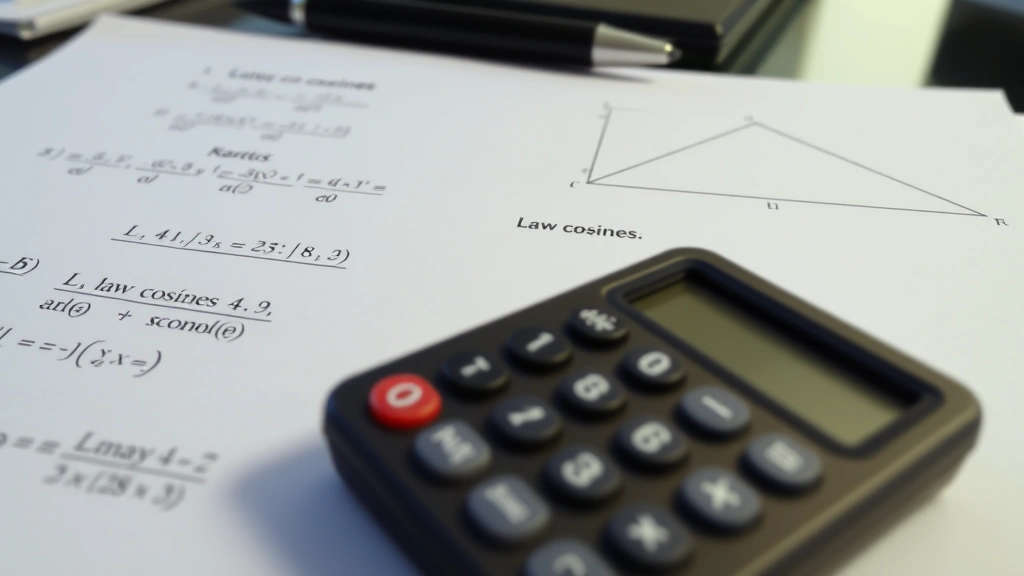
When you know two sides of a triangle and the angle between them, you can find the third side using the law of cosines. This scenario, known as SAS (Side-Angle-Side), is one of the most common applications.
Example Problem
Suppose you have a triangle where side a = 5 units, side b = 7 units, and the included angle C = 60°. Find side c.
Solution:
Using the formula c² = a² + b² – 2ab·cos(C):
c² = 5² + 7² – 2(5)(7)·cos(60°)
c² = 25 + 49 – 70·(0.5)
c² = 74 – 35
c² = 39
c = √39 ≈ 6.24 units
This calculation demonstrates how the law of cosines elegantly handles non-right triangles. The cosine of the angle is crucial because it accounts for how the two known sides relate to each other. When the included angle is 90°, the cosine equals zero, and the formula reduces to the Pythagorean theorem, confirming the law of cosines as a generalization of this fundamental principle.
In practical scenarios, such as property surveying where small claims court disputes might arise over boundary measurements, this calculation method provides mathematically rigorous evidence for establishing precise property lines.
Finding Angles Using the Law of Cosines
The rearranged law of cosines formula allows you to find any angle when you know all three sides of the triangle. This scenario, known as SSS (Side-Side-Side), requires using:
cos(C) = (a² + b² – c²) / (2ab)
Example Problem
Given a triangle with sides a = 4 units, b = 5 units, and c = 6 units, find angle C.
Solution:
cos(C) = (4² + 5² – 6²) / (2·4·5)
cos(C) = (16 + 25 – 36) / 40
cos(C) = 5 / 40
cos(C) = 0.125
C = arccos(0.125)
C ≈ 82.82°
Finding angles this way is particularly useful in navigation and surveying applications. When establishing property boundaries or resolving disputes about land measurements, knowing the exact angles of a triangular parcel becomes essential. Understanding mediation versus arbitration approaches for resolving property disputes often involves presenting such mathematical evidence clearly and convincingly.
The inverse cosine function (arccos) converts the cosine value back into an angle measurement. Most calculators have this function, typically labeled as cos⁻¹ or arccos. Always ensure your calculator is set to the correct angle mode (degrees or radians) before computing the inverse cosine.
Real-World Applications
The law of cosines appears in numerous practical applications beyond academic mathematics. Understanding these real-world uses helps contextualize why this formula matters and how it solves genuine problems.
Navigation and GPS
GPS systems and navigation applications use the law of cosines to calculate distances between locations on Earth’s surface. When you need to find the direct distance between two points given their coordinates and the angle between them, the law of cosines provides the mathematical foundation for accurate calculations.
Surveying and Land Measurement
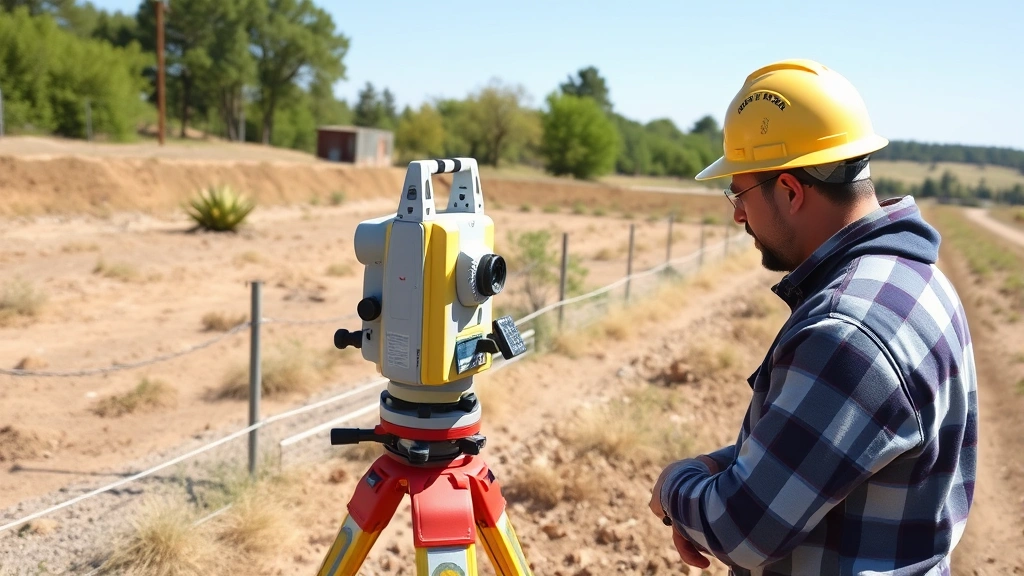
Professional surveyors rely on the law of cosines when measuring irregular parcels of land. When measuring distances and angles in the field, surveyors use theodolites and other instruments to collect data, then apply the law of cosines to calculate precise boundary lines and property dimensions. This mathematical precision is crucial for choosing a lawyer specializing in property disputes, as they’ll need expert testimony based on these calculations.
Engineering and Construction
Engineers use the law of cosines to calculate forces, stresses, and structural angles in construction projects. When designing bridges, buildings, or mechanical systems, engineers must account for angles and distances that don’t form right angles, making the law of cosines essential for accurate structural analysis.
Astronomy and Space Science
Astronomers apply the law of cosines to calculate distances between celestial objects and to determine angles of observation. Understanding the geometry of space requires these calculations for determining orbital mechanics and stellar positions.
Maritime Navigation
Ship captains and maritime navigators use the law of cosines to plot courses and calculate distances across water. Given multiple reference points and the angles between them, mariners can determine their exact position and the shortest route to their destination.
Common Mistakes to Avoid
Understanding common errors helps you avoid them and solve problems more accurately. Many students and professionals make predictable mistakes when applying the law of cosines.
Angle Mode Confusion
The most frequent error involves calculator angle modes. If your calculator is set to radians but you input degree measurements (or vice versa), your results will be completely incorrect. Always verify your calculator’s angle mode before beginning calculations.
Misidentifying the Included Angle
The angle in the law of cosines formula must be the angle between the two known sides. Using an angle that isn’t between those sides produces incorrect results. Carefully identify which angle is actually between your known sides.
Arithmetic Errors in Complex Calculations
The law of cosines involves multiple steps: squaring values, multiplying, subtracting, and potentially taking square roots. Each step introduces opportunities for arithmetic mistakes. Calculate slowly and carefully, preferably writing out each step to catch errors.
Forgetting to Take the Square Root
When finding a side length, remember that you must take the square root of your final result. The formula gives you c², not c. This step is easy to overlook but essential for correct answers.
Assuming All Triangles are Right Triangles
The law of cosines applies to all triangles, but many people default to the Pythagorean theorem even when dealing with non-right triangles. Use the law of cosines whenever you have any triangle that isn’t explicitly stated to be a right triangle, or when you have a right triangle but lack the specific information required for the Pythagorean theorem.
Practice Problems and Solutions
Problem 1: SAS (Side-Angle-Side)
In triangle ABC, side a = 8 cm, side b = 10 cm, and angle C = 45°. Find side c.
Solution:
c² = 8² + 10² – 2(8)(10)cos(45°)
c² = 64 + 100 – 160(0.707)
c² = 164 – 113.12
c² = 50.88
c ≈ 7.13 cm
Problem 2: SSS (Side-Side-Side)
In triangle ABC, side a = 3 units, side b = 4 units, and side c = 5 units. Find angle A.
Solution:
cos(A) = (b² + c² – a²) / (2bc)
cos(A) = (16 + 25 – 9) / (2·4·5)
cos(A) = 32 / 40
cos(A) = 0.8
A = arccos(0.8)
A ≈ 36.87°
Problem 3: Practical Application
A surveyor measures two sides of a triangular property: side 1 = 120 meters, side 2 = 150 meters, with an included angle of 75°. Find the length of the third side.
Solution:
c² = 120² + 150² – 2(120)(150)cos(75°)
c² = 14,400 + 22,500 – 36,000(0.259)
c² = 36,900 – 9,324
c² = 27,576
c ≈ 166.06 meters
These practice problems demonstrate various scenarios where the law of cosines applies. Working through multiple problems builds confidence and fluency with the formula, much like how understanding non-disclosure agreements requires studying multiple examples and applications.
FAQ
What is the difference between the law of cosines and the law of sines?
The law of sines relates sides to angles using sine functions and works well when you know an angle and its opposite side. The law of cosines relates sides and angles using cosine functions and works best when you know two sides and an included angle, or all three sides. Choose based on the information you have available.
Can the law of cosines be used for right triangles?
Yes, the law of cosines applies to right triangles. When one angle equals 90°, the cosine of that angle is zero, and the formula simplifies to the Pythagorean theorem. This demonstrates that the Pythagorean theorem is a special case of the law of cosines.
What angle measurement should I use: degrees or radians?
Either degrees or radians work, but you must ensure your calculator is set to the corresponding mode. Degrees are more intuitive for most people, while radians are standard in advanced mathematics. Choose whichever your problem specifies, and verify your calculator’s setting before calculating cosine values.
How accurate should my answer be?
The appropriate precision depends on your context. For academic problems, match the precision of the given information. For practical applications like surveying, use significantly more decimal places to ensure measurements are accurate enough for their intended purpose.
What if I get a negative value under a square root?
This indicates an error in your previous calculations or that the given measurements don’t form a valid triangle. Check your arithmetic and ensure the triangle inequality theorem is satisfied: the sum of any two sides must exceed the third side.
How do I know which form of the law of cosines to use?
If you’re finding a side, use the form c² = a² + b² – 2ab·cos(C). If you’re finding an angle, use the rearranged form cos(C) = (a² + b² – c²) / (2ab). Your known information determines which form applies to your situation.


